Like many people these days, I use tools like ChatGPT, Gemini, and Perplexity to handle a lot of the heavy lifting when I’m researching a topic online. They’re fast, convenient, and surprisingly good at pulling together information that would otherwise require opening a dozen browser tabs. When I’m trying to understand a complex subject quickly, AI-powered search can feel like having a helpful research assistant sitting next to me.
But I don’t necessarily want to live in a world where every online search is filtered through AI. Every now and then, I deliberately switch back to traditional search results. There’s something valuable about seeing multiple sources lined up in front of you, comparing viewpoints, checking who said what, and deciding for yourself which information deserves your trust. It’s a bit like walking through a bookstore instead of asking someone to summarize every book on the shelf. The summary may be useful, but sometimes the interesting details live in the pages that never make it into the recap.
That’s one of the biggest trade-offs with AI-powered search. It adds an interpretation layer between you and the original information. While AI can summarize and synthesize content remarkably well, it can also smooth over disagreements, skip important context, or leave out nuances that might matter. In many cases, that’s perfectly fine. In others, especially when you’re researching a purchase, a health topic, a major news event, or a controversial issue, seeing the original sources can be just as important as reading the summary.
If you’ve found yourself feeling the same way, you’re not alone.
The challenge, of course, is that avoiding AI during online research has become increasingly difficult. Search companies seem determined to put AI everywhere. What started as enthusiasm for generative AI has, in some cases, evolved into a full-blown obsession. Open a search engine today and there’s a good chance an AI-generated answer will greet you before the traditional links even have a chance to introduce themselves.
For users who simply want a list of websites, that can feel a little like asking for directions and receiving a motivational speech first.
Fortunately, the situation isn’t hopeless.
While Google continues to push AI-powered experiences deeper into Search, there are still ways to take back some control. You can switch your default search engine in Chrome, choose alternative search providers that emphasize traditional results, or even move to browsers from companies that haven’t turned every search box into an AI chatbot.
How to ditch AI and switch to retro style for your Internet research
To show how easy it is to reclaim a more traditional search experience, I’ll start with the browser most people already use: Chrome.
Launch Chrome and open a new tab. Chances are you’ll immediately see how much AI has worked its way into the experience.
The address bar displays the familiar “Search Google or type a URL” prompt, but you’ll likely also notice an “Ask Gemini” option nearby.
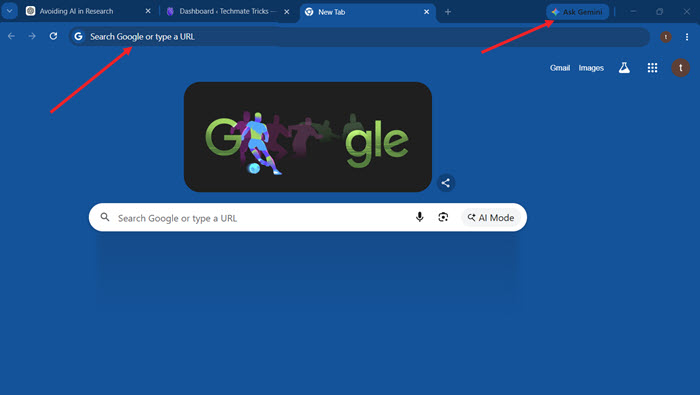
In the center of the page, the search box still says “Search Google,” yet the “AI Mode” button sitting beside it is hard to miss.
If you’d rather see classic search results instead of AI-generated summaries, changing Chrome’s default search engine takes only a minute.
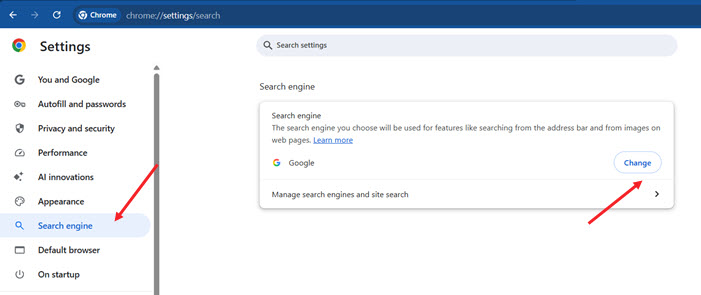
Click the three-dot menu in the upper-right corner of Chrome and select Settings. From there, look for the Search engine section in the sidebar.
Inside the Search engine settings, click Change next to your current default search provider. Chrome will present a list of available search engines that can handle searches from both the address bar and the search box.
Select DuckDuckGo and click Set as default.
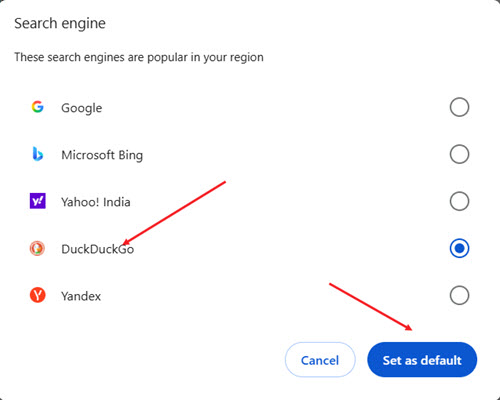
That’s it.
From that point forward, searches you perform from Chrome’s address bar will be routed through DuckDuckGo instead of Google. It’s one of the simplest ways to sidestep Google’s increasingly AI-heavy search experience and return to something that feels a bit more old-school. No AI overviews, no chatbot waiting in the wings, and no summaries trying to read the web on your behalf before you’ve had a chance to read it yourself.
In all, If AI-powered search starts feeling more like a gatekeeper than a guide, this alternative can help you get closer to the web as it was originally designed: a place where you discover information, compare perspectives, and draw your own conclusions.
Note: None of this requires giving up modern technology or declaring war on artificial intelligence. In fact, AI remains an incredibly useful tool when used intentionally. The goal isn’t to avoid AI completely. It’s to decide when you want an AI-generated summary and when you’d rather explore the source material yourself.